Ecological Importance
Although tropical cloud forests cover less than 10 percent of Tariquía, this habitat is of greatest interest to conservation in the reserve. These rare tropical cloud forests are of conservation importance due to their richness in plant and animal life, much of which is endemic. The cloud forests and other ecoregions within the reserve provide a home to such rare animal species as the spectacled bear, jaguar, llama, alpaca, vicuña, rhea, giant anteater, and the giant Amazon River turtle. Endemic species harbored in Tariquía include the rufous-throated dipper, and a great variety of forest species such as cedar and tipa.
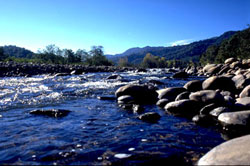
Tariquía’s watersheds are also critical for local water supplies. Downstream, people depend on the watershed as the main water source in the region both for agriculture and urban centers.
Threats
Tariquía is threatened by local and migratory cattle grazing, slash-and-burn agriculture, timber extraction, lack of clear boundary demarcations, and the construction of access roads into the reserve. In addition to slash-and-burn agriculture, local farmers often employ innappropriate agricultural practices, including insufficient crop rotation periods, cultivation on steep slopes, and unregulated length of fallow periods. Moreover, fishing with dynamite threatens native fishes and important mammal species are being depleted due to illegal hunting. Road construction also poses threats to the reserve as road access greatly encourages clearing for agriculture and rampant timber harvesting.
A Strategy of Success
Before Parks in Peril (PiP), Tariquía only existed as a “paper park.” With PiP resources, Tariquía’s partner organization, Protección del Medio Ambiente (PROMETA), began to transform Tariquía into a healthy reserve.
Due to the large number of people using Tariquía in unsustainable ways, planning an effective conservation strategy for the reserve was a difficult task. The control and oversight program began in 1994 and was highly effective in reducing hunting and dynamite fishing by 70 percent and illegal logging by 90 percent during its five years of operation. Local people were hired for the 15 park guard positions as well as a protection chief to implement and enforce the program.
Before PiP intervention, scientific research and environmental monitoring had not been carried out. With PiP funds, a robust research program was created, with a focus on the existing relationship of local communities and biodiversity. Ongoing projects include natural resource management, access and evaluation by local communities, identification of local impacts on natural ecosystems, and sustainability potential through traditional knowledge. PROMETA conducted training for local residents in alternative production activities, including horticulture, carpentry, agroforestry, beekeeping, and animal husbandry.
With the help from PiP, the environmental education program was able to administer a much needed communication strategy. Three documentary films, 35 radio “jingles”, and 30 radio and TV programs were produced in order to promote the conservation of Tariquía. In addition, an environmental education manual for teachers was produced along with an agreement signed with the Department of Education to introduce the environment as a cross-cutting theme in classrooms.
PiP was the first program to promote natural resource conservation and sustainable use in Tariquía. This provided the initial basic foundation for operations and upon consolidation PiP only had to contribute 20 percent of the funding. PiP support was also a catalyst in strengthening PROMETA, an organization that continues to manage the reserve today.
Read more about Tariquía...
Protección del Medio Ambiente (PROMETA)
The Nature Conservancy in Tariquía
Read more about projects in Bolivia...
Amboró-Carrasco National Parks
Eduardo Avaroa National Parks
Noel Kempff Mercado National Park
Bolivian Partner Organizations
The Nature Conservancy in Bolivia






)