Ecological Importance
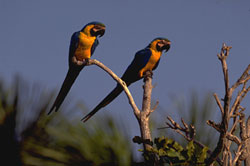
Bahuaja-Sonene National Park is home to an array of endemic and endangered wildlife, including marsh deer, maned wolf, jaguar, and large giant river otter populations. Up to 580 different birds have been recorded, most notably, the harpy eagle and seven species of macaw. Numerous reptile species such as the anaconda and taricaya turtle have been recorded as well.
In addition to its extraordinary fauna, Bahuaja-Sonene is also home to Peru’s largest population of Brazil nut trees, with over 30,000 hectares of land. The park also protects a number of native fruits, including wild pineapple and guava.
Threats
Although Bahuaja-Sonene’s size lessens immediate threats to the reserve, human activity is increasing. The construction of several major highways from Bolivia to Peru has brought increased colonization to the entire park. With easier access to the park, over-hunting of monkey, tapir and taricaya turtle, along with illegal logging of hardwoods, threaten the park’s integrity. The Ese’Eja indigenous population practices subsistence hunting in nearby areas, yet unsustainable hunting and fishing occurring outside of the park pushes subsistence hunters into the park. High impact agricultural methods involving chemicals and fertilizers in Bahuaja-Sonene’s buffer zones contaminate soil and local water sources. During the PiP project in Bahuaja-Sonene, the oil company Mobil of Peru was exploring petroleum opportunities in the Tambopata Candamo National Zone of the park.
A Strategy of Success
Bahuaja-Sonene was merely a “paper park” until 1990 when PiP resources elevated it to a fully-operating park with recognition as one of the best-managed sites in the region. The most significant accomplishment of PiP at Bahuaja-Sonene is undoubtedly the promotion of the original Pampas del Heath Sanctuary at the national and international level combined with the persistent efforts of the Peruvian government to expand the park by 537,000 hectares to the internationally-recognized Bahuaja-Sonene National Park that it is today.
At the outset of PiP funding, the program improved the physical protection of the park by hiring 10 park guards and a park director, constructing and refurbishing infrastructure used for patrolling, visiting and research, installing a radio communication system, and creating a voluntary park guard program. PiP has provided funding for several conservation studies, including examining fire management in the Pampas area and developing a mapping system of regional vegetation cover through the use of aerial and satellite images.
PiP has helped to strengthen the relationships with key stakeholders such as local communities and the Peruvian government. Public awareness about the need for conservation in the park has increased among local native and colono communities. Some of the park’s most-accomplished guards who were once hunters are now guardians of the forest. In addition, Bahuaja-Sonene has been recognized for its expertise in conservation, which has led to increased governmental financial support for the park.
PiP was also able to strengthen its partner organization, ProNaturaleza (PN), by training field and administrative staff and its board of directors. In 1996, PiP’s project manager, Fernando Rubio, was awarded the Parker Gentry Award from the Chicago Field Museum for outstanding conservation at the Pampas Sanctuary. PN also worked as a mediator between local communities and the local government to ensure that communities’ basic needs were being met. With this relationship, PN was also able to focus on community-based conservation and sustainable development. In one case, the native community of Sonene participated in a sustainable turtle-breeding project where the community’s protein needs were met and 1,435 turtles were released into the wild.
PiP presence at Bahuaja-Sonene has resulted in the reduction of several key threats. Recent satellite imagery shows the recovery of much of the forest damaged by illegal logging during between 1990 and 1998. Brazil nut extraction has also been controlled and areas have been declared off limits to human activity. Commercial hunting has been reduced through law enforcement, with native communities continuing to hunt for subsistence purposes within permitted quotas. PiP funding has established the groundwork for conservation in Bahuaja-Sonene, and at the time of site consolidation a National Trust Fund for the Environment was created to support future conservation activities.
Read more about Bahuaja-Sonene...
ProNaturaleza
Read more about projects in Peru...
Central Selva/Yanachaga-Chemillén National Park
Pacaya-Samiria National Reserve
Paracas National Reserve
Peru Partner Organizations
The Nature Conservancy in Peru






)